
Meridian Directory Holdings
Old directories reward patient searching. A Meridian city directory can turn a half-remembered name or a family business into a real historical trail, and it works best when you search the spelling used at the time. Compare each entry with nearby addresses and with later records to see how a household shifted. Some volumes sit on archive shelves. Others exist as scans or catalog descriptions. An entry can place a person at a moment in time, but only when you record the year and the source. It says nothing about who lives at an address today.
| Collection | Years | Where Held | Access |
|---|---|---|---|
| Meridian city directories | 1888, 1899, 1901/02, 1904/05, 1908/09, 1910/11, 1911/12, 1913/14, 1915/16, 1918/19, 1928, 1931, 1935, 1937, 1939, 1941, 1944, 1946, 1948, 1950/51, 1953, 1955, 1956, 1958, 1959 | MDAH Media Room | Open shelf, non-loan |
| Meridian, Mississippi Directories | 1926 | Google Books, original New York Public Library | Free OCR and scan |
| Meridian Sanborn maps | 1885, 1889, 1893, 1898, 1912, 1925/1967 corrections | LOC, MSU, and ProQuest routes | Map and structure context |
| Lauderdale County archival series | 1202: 1835–1866 groups; 0355: 1916–1932 groups | MDAH Digital Archives | Finding-aid and item route |
Never assume an unlisted year is gone for good. Never expect every catalog group to share a format. Record the volume year and the catalog item before anything else. The Meridian holdings have gaps. No continuous publication run is established, and no complete local reverse-directory run appears either. Note: The catalog list shows located volumes only, not a full publication history or the contents of every directory.
Meridian Directory Media Room
The MDAH catalog record for Meridian directories lists the Media Room holdings as open shelf, not for loan. The call number follows the pattern MM/917.62CD/Meridian, and the catalog carries a note about Primary Source Microfilm publication from 1999 onward. That note covers the cataloged media. It does not date every original directory. Before copying a name or address into a research log, check the shelf grouping and the exact year.
When an online search for the Meridian residents directory comes up empty, the MDAH research rooms and catalog are the fallback. A focused request should name the place, the directory year, the surname or address, and whether an image or an availability check is needed. MDAH directs research questions to its research services, reachable at refdesk@mdah.ms.gov and 601-576-6876, with current fees to be confirmed.
Meridian 1926 Directory Scan
The 1926 Meridian directory at Google Books comes from the New York Public Library. It was digitized on April 23, 2025. Its OCR layer carries Polk & Co. vocabulary. It surfaces names, street addresses, occupation text, and short forms. The abbreviations read like a period shorthand: auto mech, barber, bkpr, carp, cashr, driver, firemn, mach, pntr, sten, swtchmn, tchr, and trav. Those snippets are a strong locating aid. They help when a surname is hard to spot.
Treat OCR as a pointer, not a transcription. Search it to find a likely page. Then inspect the image itself for spelling, line breaks, initials, and the neighboring entries. Read any spouse reference, telephone, owner mark, employer, widow notation, or household order directly from the scan. Do not assume it.
The Google Books edition record documents the source of this 1926 scan.
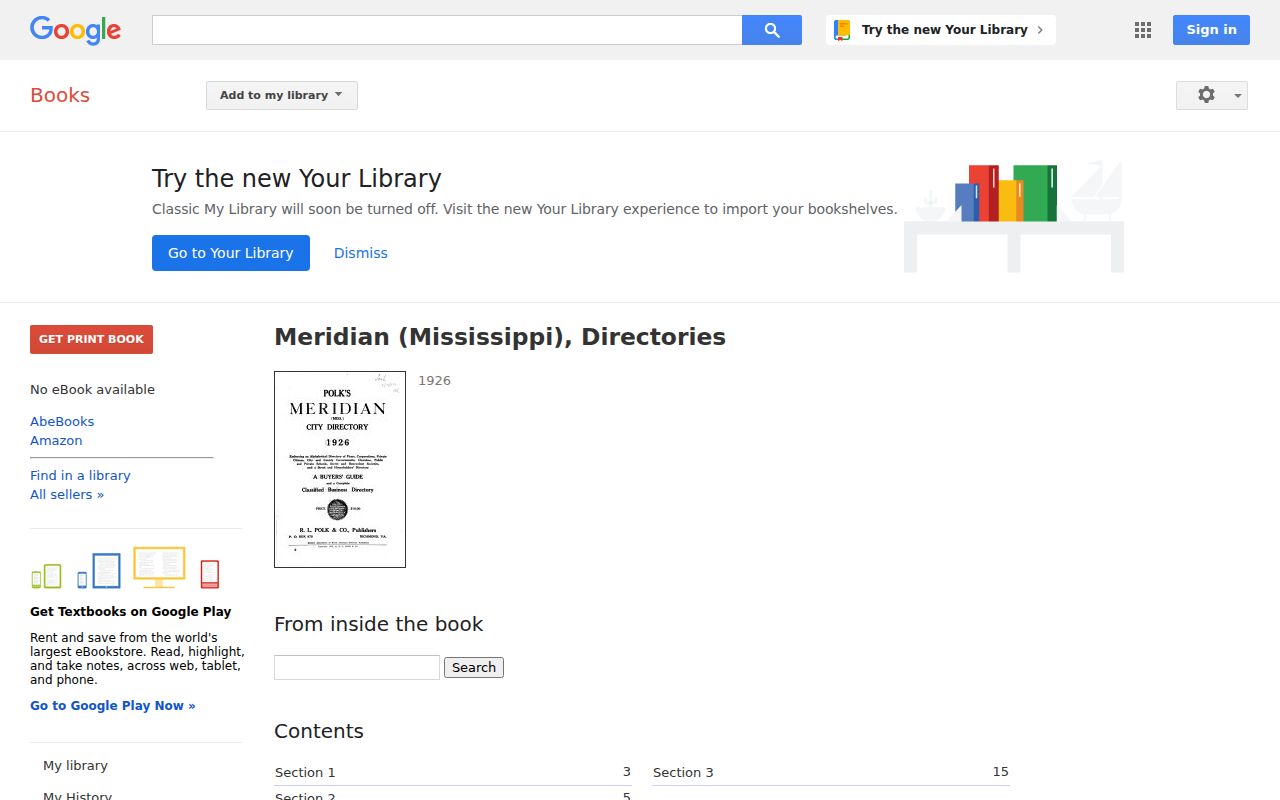
The image is a lead, not a finished citation. A usable Meridian city directory citation needs the volume year, the page, an image check, and the exact text read.
Read a Meridian Directory Entry
A directory entry is a dated printed listing. In the 1926 OCR, the visible fields are a name string, a street address, and an occupation abbreviation. Other details turn up in some editions, but confirm them on the page before using them. The volume's abbreviation key is part of the record. It gives each term its period meaning. That keeps a short label from becoming an unsupported family conclusion.
| Name string | The name or initials printed in that edition; compare alternate spellings and married surnames. |
|---|---|
| Street address | A dated location in the directory, not proof of current residence or title. |
| Occupation text | Confirmed in 1926 OCR, often abbreviated; read it against the scan and its key. |
| Nearby entries | Useful context for a household or address, but not a stated relationship unless the page says so. |
| Edition-specific marks | Inspect the image for spouse, telephone, employer, owner, or widow details before recording them. |
- Criss-cross directory
- An address-order directory section, when a volume includes one, used to approach a place rather than a name.
- Householder index
- An index organized around household names; it should be read as the volume labels it, not treated as a full census.
- Abbreviation key
- The volume's explanation of short forms. Photograph or note it before expanding a label in research notes.
Note: Transcribe only fields visible in the chosen edition, since a feature present in one directory may be absent from another.
Meridian Directory Timeline
The holdings form distinct checkpoints, not an unbroken annual sequence. A timeline keeps a researcher from quietly filling a gap with a neighboring year's listing. It also separates the MDAH shelf years from the independent digitized 1926 edition.
- 1888: the earliest Meridian directory year listed in the MDAH catalog.
- 1899–1918/19: selected turn-of-the-century and early twentieth-century MDAH holdings, including several paired year labels.
- 1926: the separately digitized Google Books and NYPL volume.
- 1928–1959: selected MDAH holdings, with the last listed volume dated 1959.
The list reflects catalog holdings alone. It does not give life dates or the span of a household at an address. A gap may simply mean the checked collection lists no volume for that year. Note: Keep the catalog title, edition year, page, and image-versus-OCR distinction together in every citation.
Meridian Directories and Sanborns
A house-history question usually pulls on two different sources. The city directory gives a dated listing of who was at an address. A Sanborn sheet, by contrast, shows the building itself. Mississippi State University frames the maps as tools for architecture and fire-risk study. Its Meridian years cover 1885, 1889, 1893, 1898, 1912, and 1925. Correction material from 1967 also exists. The Library of Congress holds the 1889 set. Its 14 sheets are free in the public domain. A sheet index plus street intersections will pin down an old address.
Timing matters here. A 1926 directory sits close to the 1925/1967 corrected map. Yet each reports a different thing. The map reveals footprint, use, construction, stories, and fire-risk clues. It never names a resident. A directory name, in turn, proves no ownership.
Note: Record the map year and sheet number with any address. Later correction material can shift the map's time frame.
Meridian Library Directory Routes
The Meridian-Lauderdale County Library genealogy report routes researchers to a Southern genealogy and family-history collection. It also covers GenealogyBank, NewsBank and HeritageHub, Fold3, and microfilm of past newspapers. The reference desk is the stated route. It is reachable at genealogy@meridian.lib.ms.us and 601-553-2459. The live genealogy page has been unreliable. Confirm current access, hours, title runs, staff research options, and scanning rules before any visit.
At the desk, ask pointed questions. Name the exact directory title. Include the shelf or call number, year run, reverse or criss-cross directories, obituary resources, yearbooks, and microfilm. A missing directory year has several fallbacks. The local library, MDAH, and the Lauderdale County archives are separate routes. A request that names a year, surname, address, and desired copy type beats a broad plea for everything about a family.
Mississippi Historical Society local-history listings open another route. They lead to the Lauderdale County Department of Archives and History.
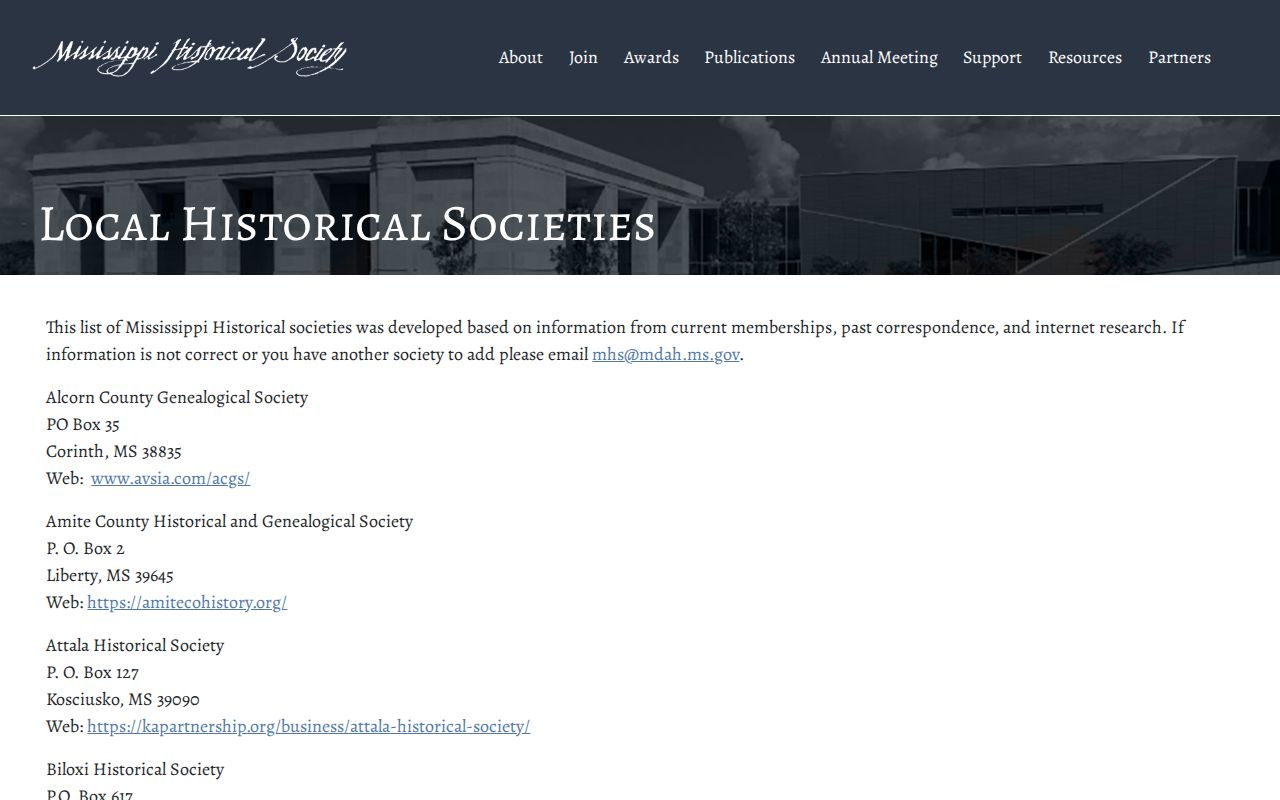
That listing helps you find an archive contact path. It does not confirm any particular directory or surname sits in that collection.
Trace Meridian Directory Households
Keep every result tied to its date. Start with one address or one name in a single directory year. Then check adjacent entries. Repeat the search across annual or five-year intervals where holdings allow. Compare initials, alternate spellings, and married surnames before treating two entries as the same person. Directories mislead through small variations. Pair each directory year with the nearest legally released federal census. Do not read a census as a current household list.
- Record the first usable name, address, year, page, and whether the text came from OCR or the image.
- Search the next available Meridian directory year, including initials and likely surname variants.
- Read adjacent entries and any address-order section only as dated context.
- Compare the sequence with the closest publicly released federal census and note conflicts instead of forcing a match.
- Use newspapers, probate, cemetery, church, or archive material as separately dated corroboration.
A disappearance has many possible causes. It may signal a move, a death, or a changed name. It may also mark an unprinted listing or an OCR miss. Nothing about the gap settles the reason on its own. Federal census images follow a 72-year public release rule. So the latest lawful census serves as the right comparison point.
Note: A census and a directory stay separate dated sources. Keep both citations even when they appear to agree.
Meridian Directory Listings Have Limits
A dated city directory listing is not current identity. It is not present residence, ownership, relationship, or legal status. The same caution extends to a parcel card and a map. Property questions demand care with labels. A directory address, parcel situs, owner-address display, legal description, and postal label each come from a different record system. Each may describe the same place differently.
Strong historical work preserves the source, year, page, field, and confidence level for every result. Common names, OCR errors, changed surnames, and relatives sharing one address all demand more than a single identifier. Never use historical names or addresses to track or harass a living person.
Practical check. Search OCR for a likely page, then verify the spelling and address on the scan before adding it to a family or house-history timeline.
Meridian Fire History and Addresses
Fire shaped Meridian's built environment. City Fire Department history records the 1915 Great West End Fire, which destroyed 52 houses. That event explains why a directory, a Sanborn sheet, a deed, and a planning record may tell different parts of one address story. It reveals nothing about who lived in any particular structure. It does not show whether a named person was affected or which address changed afterward.
Rail growth also built the city. Railway arrival came in 1855, and the destruction of 1864 forced a rebuild. The 1890–1930 span is described as a Golden Age. Use that context to pick relevant map and directory dates, then let the dated records carry every person and property claim.
Citing Meridian Directory Evidence
Start hard cases at the MDA catalog, the library reference desk, or an archive finding aid. Hard cases need a clear request. State the county. Give the record series or directory title. Add the date span, surname or address, and desired output. Say whether an uncertified scan works. MDAH's county inventory is a finding aid. It is not a promise that a record image sits online. County archives and MDAH can confirm availability first. That step saves hours otherwise lost to a broad search.
Keep a full citation in one note. Record the directory edition and year. Add the page, source link, image or OCR status, and address type. That small record lets you revisit any result later. It also keeps a historical clue from hardening into an unsupported modern claim.
Note: For the 1926 scan, cite only the text checked on the image.