
Meridian Previous Residents by Era
Property and household questions need different sources. Lauderdale County Chancery records establish the instrument trail for a parcel. The MDAH directories and the 1926 scan supply dated name-and-address leads for Meridian. Sanborn maps describe the place itself. Federal census images, newspapers, and archives can corroborate a household at a particular time. No one source proves every occupant.
| Source | Years | Where Held | What It Shows |
|---|---|---|---|
| Lauderdale Chancery index | Search dates may begin at 1800, but actual online start is unverified | Chancery portal and courthouse | Recorded parties, instrument, date, book/page, and property fields |
| Meridian city directories | 1888, 1899, 1901/02, 1904/05, 1908/09, 1910/11, 1911/12, 1913/14, 1915/16, 1918/19, 1928, 1931, 1935, 1937, 1939, 1941, 1944, 1946, 1948, 1950/51, 1953, 1955, 1956, 1958, 1959 | MDAH Media Room | Open shelf, non-loan; dated name and address leads |
| Digitized Meridian directory | 1926 | Google Books, original NYPL scan | OCR and image leads for names, addresses, and occupation text |
| Sanborn maps | 1885, 1889, 1893, 1898, 1912, 1925/1967 corrections | LOC, MSU, and ProQuest routes | Structure, use, and fire-risk context |
| Lauderdale archive series | 1202: 1835–1866 groups; 0355: 1916–1932 groups | MDAH Digital Archives | County-record finding-aid and item leads |
Start with the best parcel clue you have. A title question points first to the tax card and the Chancery index. A household question points to the nearest directory year, then to a second dated source. The source matters as much as the name.
Meridian Chancery Record Modes
The Lauderdale Chancery index is the official land-record route. Search All, Grantee, and Grantor modes are supported. A matched-name option sits beside full-name and date fields. You can query by instrument year and number. Volume, recording location and type, book and page, legal description, parcel identifier, PPIN, subdivision and plat criteria, street and number, and consideration ranges are also searchable. A first pass may come up thin. Run the address, parcel, PPIN, legal description, and party name separately.
The form accepts an 1800 date placeholder. The official page does not state the oldest digitized or indexed year. Treat that as unknown coverage, not proof that early deeds are online. Older material may live in courthouse books or microfilm. An MDAH route or a scoped clerk inquiry may also hold it. Images and copies may sit behind a separate account, subscription, or purchase boundary.
The Lauderdale Chancery Clerk portal is the official starting point for recorded land instruments. It is also the copy-purchase route. Start there for any recorded instrument.
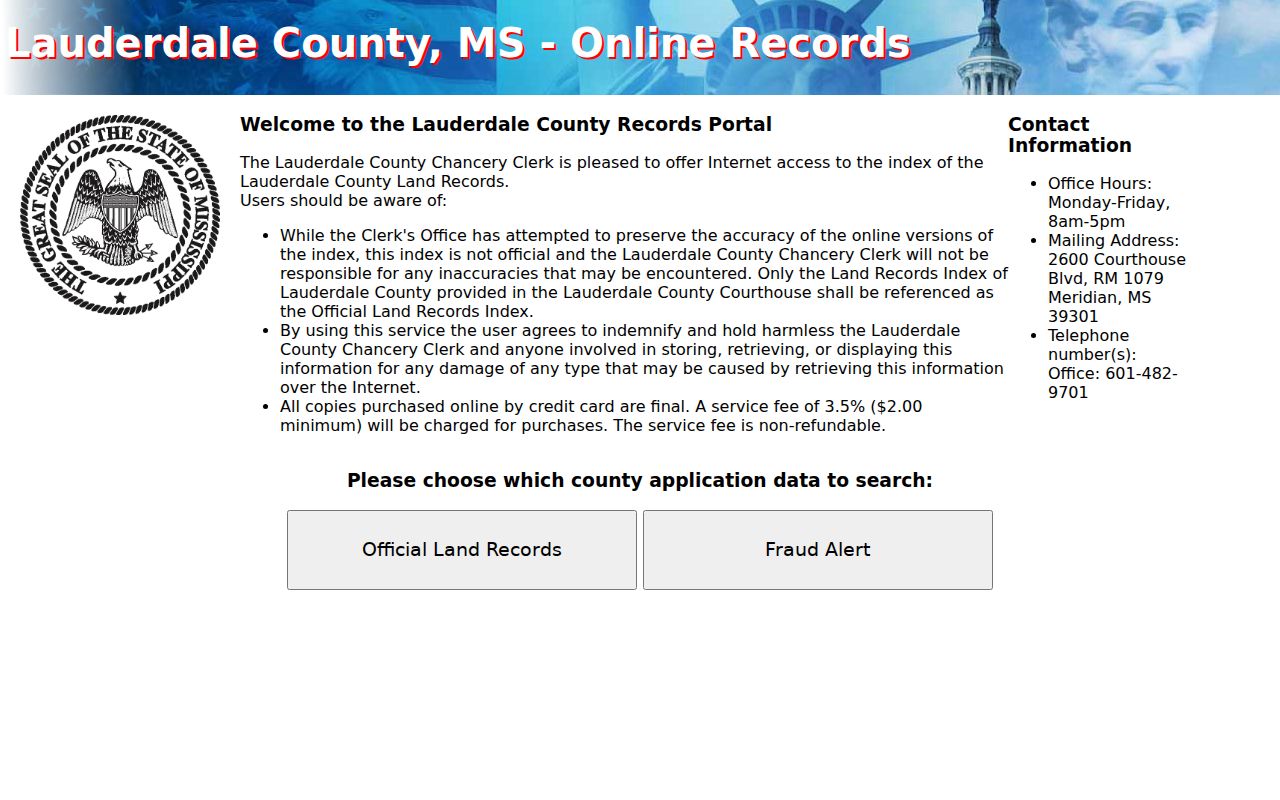
A portal match is great for building a recorded trail. It does not prove anyone lived there. An occupant claim still needs a dated record beside the deed. Use a directory, census, or newspaper item for that. Note: A date the form accepts is not verified online coverage, so ask the clerk about earlier books and images.
Trace Meridian Past Owners
Deed chains trace title backward, not occupancy. The Delta Lauderdale property hub can supply an owner display, situs, parcel number, PPIN, legal description, tax fields, and a book/page reference. Carry that parcel key into the Chancery search. Street labels change over time. The legal description remains the property's identity in the recorded trail.
- Capture the exact situs, parcel number, PPIN, legal description, book/page, tax year, and displayed update date from the tax card.
- Use the current recorded party or book/page in the Chancery index to locate the purchase instrument.
- Read the seller as the earlier owner lead, then search that party as grantee to locate the prior acquisition.
- Repeat backward through deeds, releases, easements, trusts, plats, and corrections while preserving dates and related instruments.
- When the needed period falls outside confirmed online coverage, ask the Chancery Clerk, courthouse books, MDAH, or microfilm route for the earlier record.
- Grantor
- The party transferring an interest in a recorded instrument.
- Grantee
- The party receiving an interest in that instrument.
- Chain of title
- The linked series of recorded transfers and related instruments for a property.
- Legal description
- The lot, block, subdivision, survey, or metes-and-bounds description that identifies land apart from a postal address.
Meridian Previous Residents and Tax Cards
A tax card is often the fastest way to find a parcel. It is not an occupant record. The Delta sample keeps owner and situs displays separate. Values, tax payment, legal text, PPIN, book/page, and an update date round out the card. The portal offers 2026 Proposed and 2025 Current Year options. A value or owner display is incomplete research without its tax-year label.
Owner address, mailing address, and situs are different things. An owner may never have lived there. A listed address can be old. It can also sit outside Lauderdale County. Use the Delta card as a cross-reference to a recorded deed, and attach a dated directory, census, newspaper, or archive record before claiming a household. That line matters most when you trace the people, not just the title.
Evidence check. A tax-card owner display can guide a deed search, but it does not label a current or historical occupant field.
Meridian Addresses on Sanborns
Sanborn maps add a physical layer to any Meridian address. Mississippi State University lists local maps for 1885, 1889, 1893, 1898, 1912, and 1925, plus 1967 correction material. Its collection explains a focus on architecture and fire risk. The Library of Congress 1889 item holds 14 sheets. It places Meridian in Lauderdale County.
A Sanborn shows footprint, use, construction, story count, and fire-risk clues. It cannot name a resident or establish title. A 1926 directory sits close to the 1925/1967 corrected map in time. The two records still answer different questions. Preserve each source's own date. Never treat them as one combined record.
Mississippi State University's Sanborn collection identifies the Meridian map years and explains the collection's use.
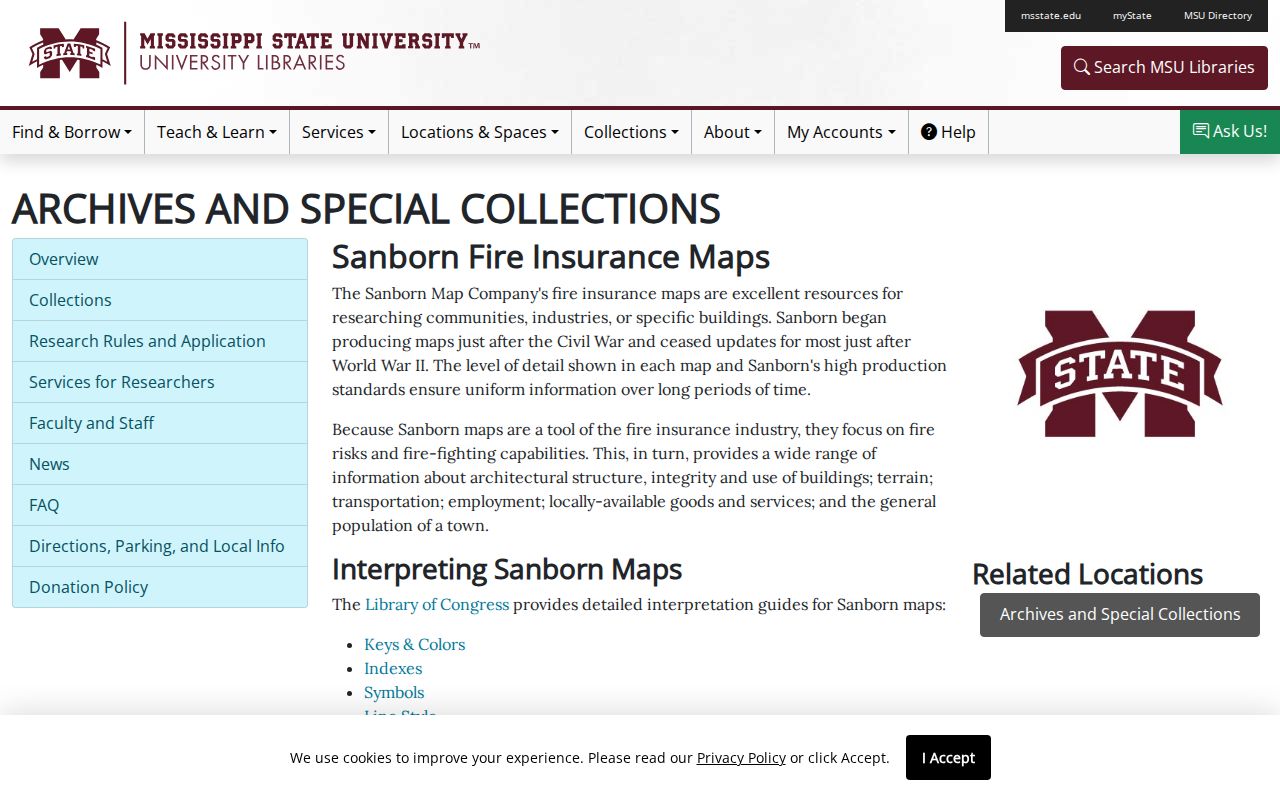
Map sheets give address context for a house-history timeline. They are not a roster of occupants. Note: Pair a directory year with the nearest map sheet, but do not turn spatial context into an occupant claim.
Meridian Past Residents in Directories
Chasing past residents of Meridian means working backward through old street directories. It does not mean working forward through deeds. The MDAH catalog holds Meridian directory volumes for selected years between 1888 and 1959. A 1926 scan also sits on Google Books. It was scanned from a New York Public Library copy. Its OCR pulls out names, street addresses, occupations, and the abbreviations each entry carries. Read the image itself, though. OCR mangles spellings and merges lines, so treat the text layer as a pointer, not proof. For criss-cross directories, yearbooks, newspaper microfilm, and other genealogy material, the library reference desk is the right first call.
A criss-cross directory flips the usual city directory order. It lists households by address instead of surname. It still reflects one dated moment. Neighboring entries prove nothing about relationships between adjacent households on their own. For collection details and help reading an entry, see the Meridian city directory collections.
- Keep the directory spelling, address, year, page, and whether the reading came from OCR or the scan.
- Search the next available directory year using initials, surname variants, and married names where supported by the source.
- Use the closest legally released federal census as a separate household check, respecting the 72-year public-release rule.
- Record conflicts between the directory and census instead of merging same-name people automatically.
- Use probate, cemetery, church, newspaper, and archive material only as separately dated corroboration.
Note: Census images follow the federal release schedule, so rely on the latest legally released schedule rather than assuming a current household.
Meridian Archive Series for Addresses
Early Lauderdale County record series start with the MDAH county inventory. Treat it as a finding aid. It describes what exists, not what has been digitized. Series 1202 covers year groups from 1835 through 1866. The digital Lauderdale County Series 0355 holds groups for 1916–1922, 1923–24, and 1925–26. It also covers 1927–28, 1929–30, 1931, and 1932. Note the series number and year group before guessing at contents.
An archive request should state the county and the series or record type. It should also give the date span and the surname or address of interest. Add the output you want and whether an uncertified scan will do. MDAH research rooms, county archives, and courthouse files are separate channels. Each has its own rules. The Lauderdale County Department of Archives and History publishes contacts and a dated location guide. Hours, copying rules, holdings, and appointment terms still need confirmation before any visit.
The MDAH county inventory remains the route for placing Lauderdale materials in their correct historical series.
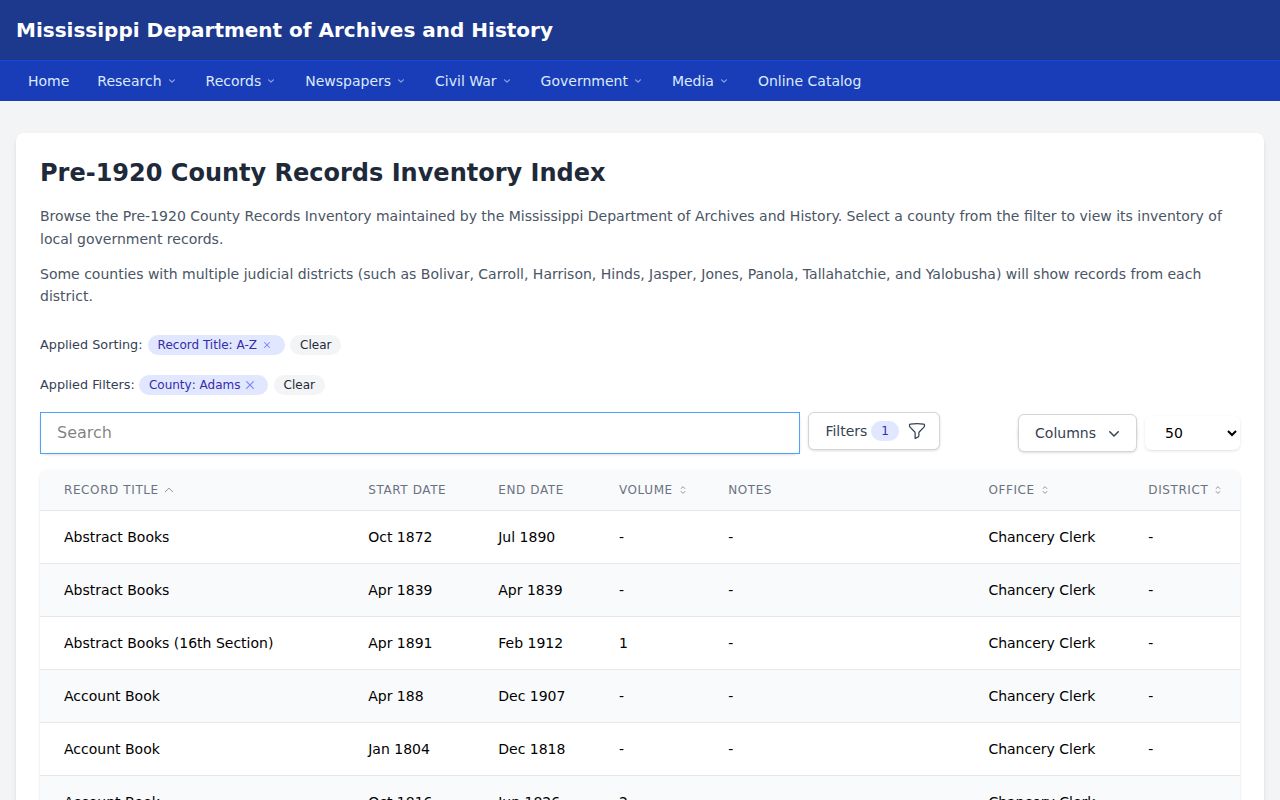
An inventory entry points you down an archive path. The item itself still decides the question. Confirm its date, format, and fit for the address before drawing conclusions. MDAH Digital Archives Series 0355 supplies the public item and year-group route for Lauderdale County.
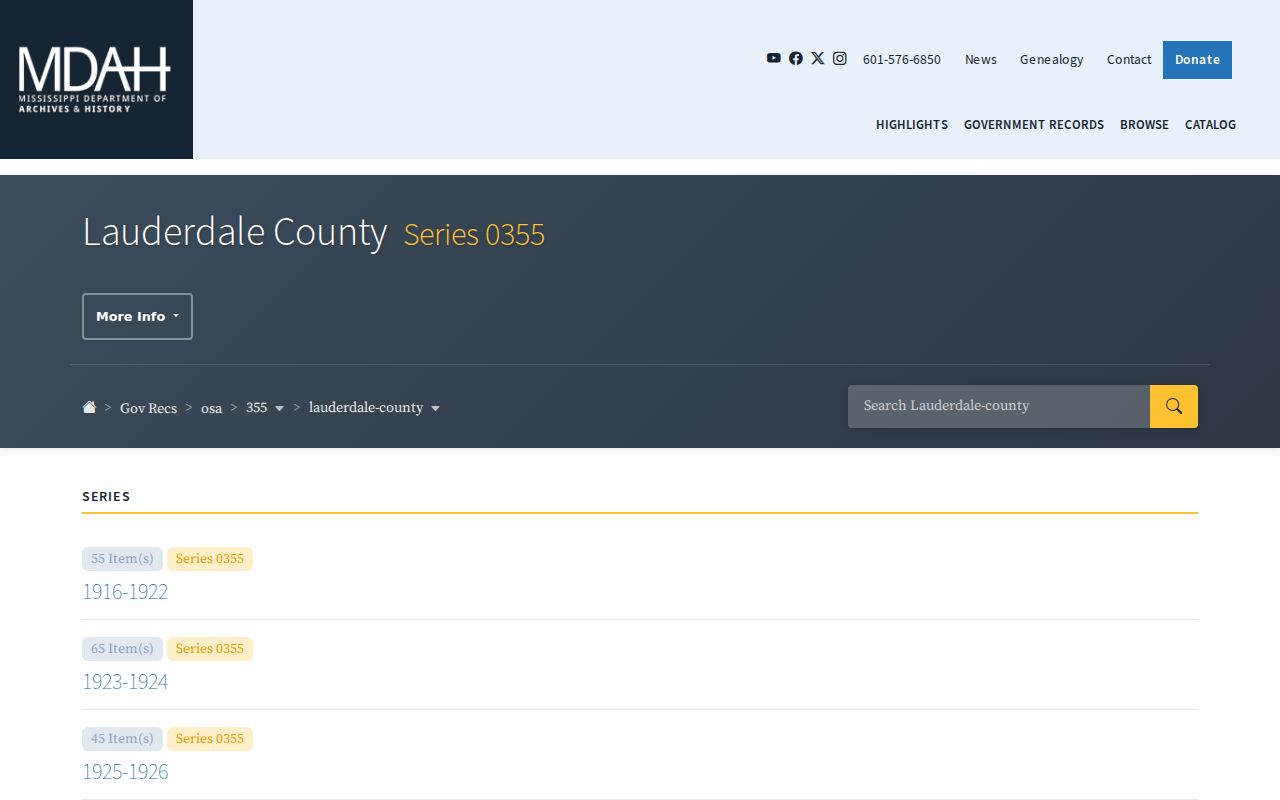
Series 0355 widens the historical trail considerably. It still cannot establish who occupied a home, or the building's present condition, on its own.
Meridian Newspaper and Archive Trails
The Meridian-Lauderdale County Library genealogy report names GenealogyBank, NewsBank and HeritageHub, Fold3, newspaper microfilm, and a Southern genealogy and family-history collection. It also fields questions at the reference desk. Reach them at genealogy@meridian.lib.ms.us and 601-553-2459. Confirm the current service and title run before planning a trip. Newspaper databases change often.
Obituaries, social notices, and news items are historical leads, not current resident data. Cite the paper title, issue date, page, and the exact form any address takes. MDAH research services can supply microfilm and manuscript leads. Staff research or images may carry a fee. The county's 2025 request form states plainly that the county provides no research services. Extensive gathering is billed at actual wages. Land-title questions should therefore start with Chancery, not a broad county request.
Note: Ask for a specific date range, address or surname, and record series. Staff cannot resolve an open-ended house-history request.
Meridian Fire History at an Address
Meridian grew up around the railroad. That is why one address can scatter its evidence across several systems. Rail service arrived in 1855 and shaped the city. Sherman's 1864 raid destroyed much of it, and the rebuilding followed. Locals call 1890–1930 the Golden Age. Each era left a different paper trail. Deeds, directories, Sanborn maps, fire records, planning files, and newspapers all capture different layers of the built environment at different dates.
City Fire Department history records the 1915 Great West End Fire, which destroyed 52 houses. That makes a solid checkpoint for West End research. It proves less than it seems. A named building, an address in its current form, and a particular household each need their own confirmation. Test every connection against the map sheet. Check the directory year, the parcel record, and a planning or newspaper source too.
Meridian Previous Residents Evidence
The strongest household-history answer is an evidence timeline. Line up the directory listing and the parcel or tax record. Add any recorded instrument, map context, a planning record, and a dated archive or newspaper reference. Label each address for what it is: directory address, situs, owner display, legal description, or postal label. Record the source date, page or record identifier, and your confidence. A matching name alone is thin evidence. OCR errors and changed surnames complicate things.
Dated records serve lawful purposes well: house history, family history, heir questions, civic curiosity. Mississippi's anti-stalking statute, Miss. Code §97-3-107, names stalking as prohibited conduct. Never use historical records to track, harass, or expose a living person. Do not try to reverse engineer protected addresses either.
House-history limit. A record can support only the dated relationship it states, so preserve uncertainty rather than naming an occupant or owner without direct evidence.